
Licensed & Insured Tree Service: What Florida Homeowners Should Know

When you're hiring someone to remove a tree, trim large limbs or clean up storm damage, you're trusting a crew to work around your home, vehicles, roof, landscaping, utility lines and other people on the property.
That's very different from hiring someone for basic yard maintenance.
Professional tree work can involve chainsaws, falling limbs, climbing, bucket trucks, stump grinders, chippers, ropes and heavy equipment. OSHA identifies falling objects, falls, chainsaw injuries and contact with energized power lines among the serious hazards associated with tree care and tree removal.
That's why one of the first questions a homeowner should ask isn't:
“How much?”
It's:
“Are you properly insured, and can I verify it?”
And in Florida, there is another important question:
“What does ‘licensed’ actually mean for this type of work?”
Does a Tree Service Need a License in Florida?

This is where homeowners often get conflicting information.
Florida's Department of Business and Professional Regulation lists tree trimming and tree removal as work that does not require a Florida state construction contractor license.
That's important.
It means you should be cautious when someone tells you that every legitimate Florida tree company must have a particular statewide “tree removal contractor license.” For ordinary tree trimming and removal, there isn't a DBPR state construction license category like there is for roofing, plumbing or electrical contracting.
However, that does not mean tree companies operate without requirements.
Depending on the business, location and exact work being performed, a company may need:
Local business registration or business tax receipts
Applicable local specialty licensing
Permits for certain tree removals
Proper commercial insurance
Required workers' compensation coverage
Appropriate licensing for work outside ordinary tree service
Compliance with OSHA workplace safety requirements
Utility coordination when electrical lines are involved
Even Charlotte County, for example, specifically notes that a local business tax receipt is not the same thing as a contractor's license.
The takeaway isn't to obsess over one piece of paper.
It's to verify that the company you're hiring is legitimately operating, properly insured and qualified for the actual work being performed.
Why Insurance Matters So Much With Tree Work
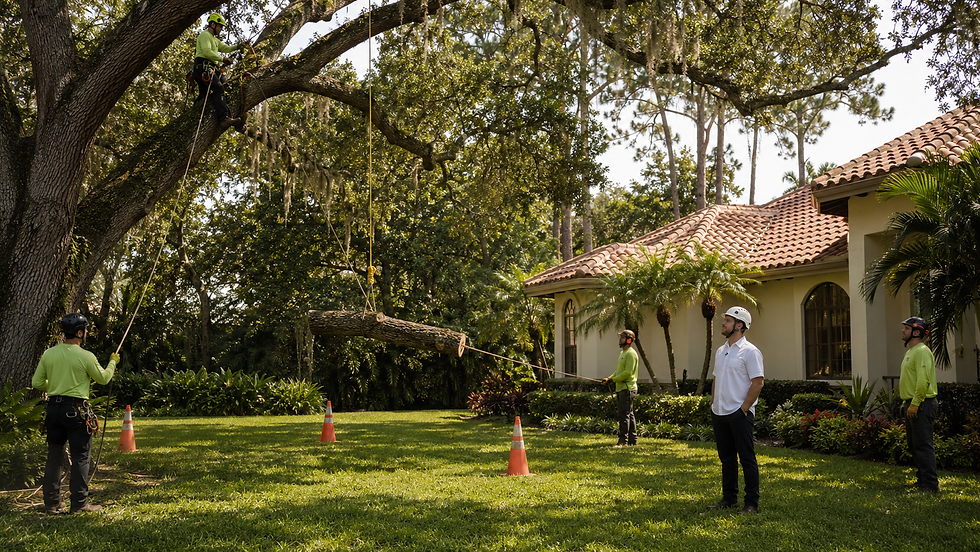
Imagine removing a large limb hanging over a screened lanai.
Now imagine that limb weighs hundreds of pounds.
Or picture a mature tree being removed between a house and a driveway containing two vehicles.
Tree work requires planning because gravity doesn't offer a redo.
Insurance isn't proof that a company will perform perfect work. What it does provide is an important layer of financial protection when legitimate accidents or property damage occur, subject to the terms and limits of the policy.
Two types of coverage homeowners commonly need to understand are:
General Liability Insurance
General liability insurance is generally intended to address third-party bodily injury and property damage exposures covered by the policy.
For a homeowner, this is particularly relevant because tree crews may be working immediately beside:
Roofs
Windows
Pool cages
Fences
Vehicles
Neighboring properties
Driveways
Outdoor structures
Don't simply accept the phrase “we're insured.”
Ask to see a current Certificate of Insurance.
Florida's Department of Financial Services specifically advises consumers working with contractors to request evidence of Certificates of Insurance for General Liability and Workers' Compensation.
Workers' Compensation
Workers' compensation is different.
Its purpose is related to workers who suffer job-related injuries or illnesses.
Florida's workers' compensation requirements vary according to factors including the type of industry, number of employees and business organization. The Florida Division of Workers' Compensation maintains both coverage and exemption databases so coverage status can be checked.
That means homeowners don't need to rely solely on someone's word.
Coverage can be verified.
“Insured” Should Mean More Than a Logo on a Truck
It's easy to print:
LICENSED & INSURED
on a business card, yard sign, trailer or Facebook page.
Verification is what matters.
Before approving substantial tree work, ask:
What company name is the insurance policy issued to?
Is the policy currently active?
Does the company have general liability coverage?
What is its workers' compensation status?
Does the insurance correspond to the business performing your work?
Will subcontractors be involved?
If so, who is responsible for those workers?
Can the company provide documentation before starting?
A professional company shouldn't be surprised by these questions.
They're normal questions when someone is performing potentially hazardous work on valuable property.
Why Tree Work Carries More Risk Than It Looks Like
A professional crew can make tree removal look deceptively simple.
A worker makes a cut.
A rope moves.
A limb comes down exactly where it was supposed to.
But there's a lot happening behind that moment.
The crew may need to evaluate:
Weight distribution
Tree lean
Defective limbs
Decay
Wind
Drop zones
Nearby structures
Rigging points
Escape routes
Equipment placement
Traffic
Electrical hazards
Ground conditions
OSHA's guidance specifically instructs tree workers to establish controlled areas, inspect trees and limbs for structural weakness, determine felling direction, plan retreat paths and keep personnel away from expected drop zones.
This isn't ordinary lawn work.
When a large limb is cut loose, its size, momentum and direction matter.
What About Tree Work Near Power Lines?
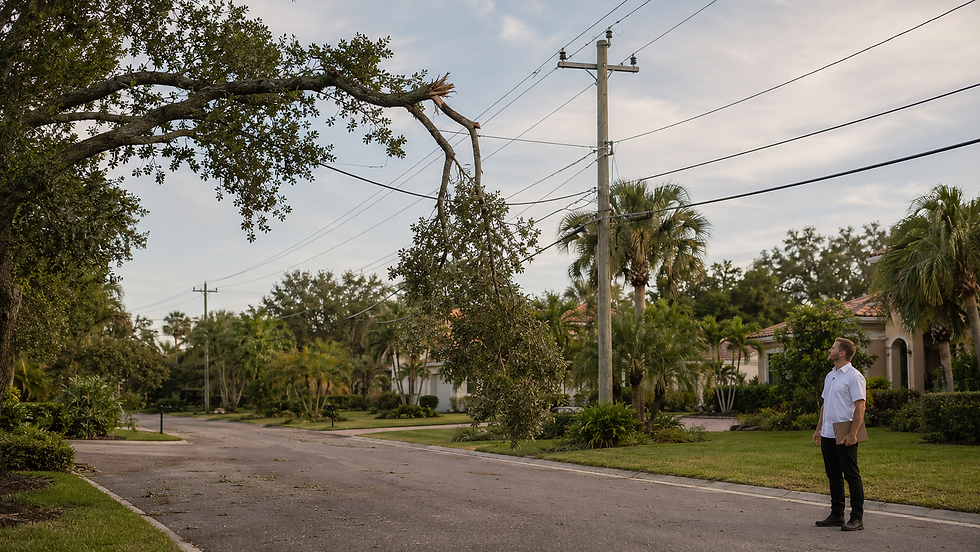
This is one situation homeowners should never take casually. Assume a power line is energized. OSHA warns that tree workers can be electrocuted not only when people or equipment directly contact energized lines, but also when branches or limbs contact them.
OSHA's tree-trimming guidance also places specific training requirements on work near electrical lines and instructs workers to coordinate with utilities when necessary.
If tree growth or storm damage is tangled in, resting on or immediately adjacent to electrical infrastructure: Don't attempt to cut it yourself.
Keep people away and contact the appropriate utility or qualified tree professional.
Storm Season Brings Another Problem: Door-to-Door Tree Crews
After hurricanes and major thunderstorms, tree work becomes urgent.
That's understandable. A tree may be blocking a driveway. A limb may be resting against the house. Streets can be filled with storm debris.
Unfortunately, urgency can also make homeowners less likely to verify who they're hiring.
A crew may appear after a storm offering immediate removal because they're “already working in the neighborhood.” That doesn't automatically mean they're illegitimate. But it doesn't mean they're legitimate either.
Before authorizing work, get the business name and verify:
Insurance
Workers' compensation status when applicable
Local business information
Written scope of work
Total price
Cleanup responsibilities
Who will actually perform the work
Be especially careful about paying the entire job in cash before work begins.
Ask What the Estimate Actually Includes
Two tree-service estimates can look completely different while describing supposedly the same job.
One might include:
Complete tree removal
Rigging
Equipment
Ground crew
Debris hauling
Jobsite cleanup
Stump grinding
Another may only include getting the tree onto the ground. Suddenly the “cheaper” estimate isn't necessarily cheaper. Before comparing price, compare the scope of work. Ask whether the estimate includes:
Tree debris removal
Will branches and trunk sections be hauled away?
Jobsite cleanup
Will smaller debris, sawdust and material be removed?
Stump grinding
Tree removal and stump removal are typically separate operations. Don't assume grinding is included unless it's written into the estimate.
Property protection
How does the crew intend to protect nearby structures, lawns, driveways and landscaping?
Equipment access
Will heavy machinery need to enter the property? Where?
Traffic or pedestrian control
Is the tree near a street, sidewalk or shared area?
Clear expectations before work begins eliminate a lot of problems later.
Don't Choose a Tree Company on Price Alone
Price matters. Nobody wants to spend more than necessary.
But a tree estimate also reflects what goes into performing the work.
Depending on the job, that can include:
Trained workers
Insurance
Specialized equipment
Commercial vehicles
Rigging equipment
Protective equipment
Fuel
Maintenance
Debris disposal
Cleanup
Administrative compliance
The lowest number on a piece of paper doesn't automatically represent the best value. And the highest number doesn't automatically mean the company is better.
Compare the company, insurance, scope of work and approach alongside the price.
Seven Questions to Ask Before Hiring a Tree Service
Before hiring someone for major tree work, ask:
1. Are you insured?
Then ask to see current documentation.
2. What does your licensing or registration cover?
Remember that Florida does not have a DBPR state construction license specifically required for ordinary tree trimming and removal. Ask what local and business credentials apply to the work being performed.
3. What is your workers' compensation status?
Florida provides a public Proof of Coverage database for verification.
4. Exactly what is included in my estimate?
Removal, hauling, cleanup and stump grinding should be clearly understood.
5. Will you use subcontractors?
If someone else will actually perform the work, ask how their insurance and coverage are handled.
6. How will you protect the surrounding property?
Especially important around homes, pool enclosures, vehicles, fences and landscaping.
7. What happens if you discover something unexpected?
A hollow trunk, hidden decay, unstable root system or electrical hazard can change how a job needs to be performed. A clear answer is better than improvisation halfway through a removal.
Red Flags Worth Paying Attention To

One unusual thing doesn't automatically mean a company is bad.
But several warning signs together deserve scrutiny.
Be cautious if someone:
Refuses to provide insurance information
Pressures you into an immediate decision
Will only provide a verbal estimate
Won't clearly identify the business performing the work
Demands full cash payment before beginning
Has no clear plan for debris or cleanup
Suggests casually cutting around power lines
Cannot explain who will actually be on your property
Tells you verification is unnecessary
Good tree service requires trust. Verification helps earn it.
How to Verify a Tree Company in Florida
You can do some of this yourself in a few minutes.
Check Florida Workers' Compensation
The Florida Department of Financial Services operates the state's Proof of Coverage database. This can help homeowners determine whether an employer has workers' compensation coverage or an applicable exemption.
Ask for a Certificate of Insurance
Request documentation showing the company and applicable coverage. Don't be embarrassed to ask.
Check the business name
Make sure the company giving you the estimate matches the company named in the documentation.
Check local requirements
Cities and counties can have their own business, permitting and tree-protection requirements. For certain trees or properties, the question may not simply be:
“Can this company cut it?”
It may also be:
“Are we allowed to remove it?”
Licensed and Insured Doesn't Replace Experience
Credentials and insurance matter. But they're part of the picture.
You also want a tree company that understands how to approach the actual job.
Someone still needs to determine:
Where the tree can safely be sectioned
What equipment is appropriate
How the property will be protected
Where branches can be lowered
Whether electrical hazards are present
What areas need to remain clear
How debris will leave the property
Think of insurance and applicable licensing as the minimum verification layer, not the entire hiring decision.
Why This Matters in Southwest Florida
Tree work in Southwest Florida comes with conditions that homeowners elsewhere may not regularly deal with.
Our trees experience:
Tropical storms
Hurricanes
Intense thunderstorms
Saturated summer soil
High winds
Rapid vegetation growth
Long growing seasons
Storm cleanup can also create situations where damaged trees are under tension, partially uprooted, hanging over structures or entangled with utilities.
That is exactly when DIY work and unverified contractors become particularly concerning.
Whether you're in Bradenton, Sarasota, Venice, Englewood, Port Charlotte, Punta Gorda or the surrounding communities, take a few extra minutes to verify who you're putting on your property.
It is much easier to check credentials before the chainsaws start.

Need Tree Work in Southwest Florida?
If you need tree removal, tree service, stump removal or storm-related tree work, Top Tier Tree & Landscaping can inspect the property, explain the scope of work and provide a free estimate. And if you want to see applicable business or insurance documentation before work begins: Ask us.
A homeowner shouldn't have to feel awkward about verifying the company working around their home. Request a free estimate today.
At Top Tier, we care about tree care.
Before hiring a tree company, what would you verify first?
Insurance coverage
Reviews and reputation
Price
What's included in the estimate
FAQs
Does Florida require a state license for tree removal?
Florida DBPR lists ordinary tree trimming and removal among trades that do not require a state construction license. Local regulations, business requirements, permits and licensing for related work may still apply.
Should a tree service have insurance?
Homeowners should ask tree-service companies for proof of appropriate insurance. Florida's Department of Financial Services specifically recommends obtaining evidence of General Liability and Workers' Compensation Certificates of Insurance when hiring contractors.
How can I verify workers' compensation coverage in Florida?
Florida's Division of Workers' Compensation maintains a public Proof of Coverage database containing coverage and exemption information.
Why is insurance important for tree removal?
Tree removal can expose workers and surrounding property to hazards involving falling branches, chainsaws, elevated work, heavy equipment and electrical lines. OSHA identifies these among the serious hazards associated with tree-care work.
Is the cheapest tree removal estimate the best option?
Not necessarily. Compare exactly what's included, such as removal, hauling, cleanup and stump grinding, along with insurance, company information and the proposed approach to the job.
EDUCATIONAL SOURCES
Florida Department of Business & Professional RegulationDBPR's consumer and license guidance specifically identifies tree trimming and removal as work that does not require a Florida state construction license.
Florida Department of Financial Services — Division of Workers' CompensationExplains Florida employer coverage requirements and provides tools for verifying workers' compensation coverage.
Florida Department of Financial Services — Insurance Consumer AdvocateRecommends verifying workers' compensation coverage and obtaining Certificates of Insurance for General Liability and Workers' Compensation.
Occupational Safety and Health AdministrationProvides federal safety guidance regarding tree removal, chainsaws, falling objects, aerial work and electrical hazards.

Comments